University of Central Florida Undergraduates Contribute to 2026 International Coastal Cleanup at Apollo Beach
By Landry Goodwin and Dr. Linda Walters
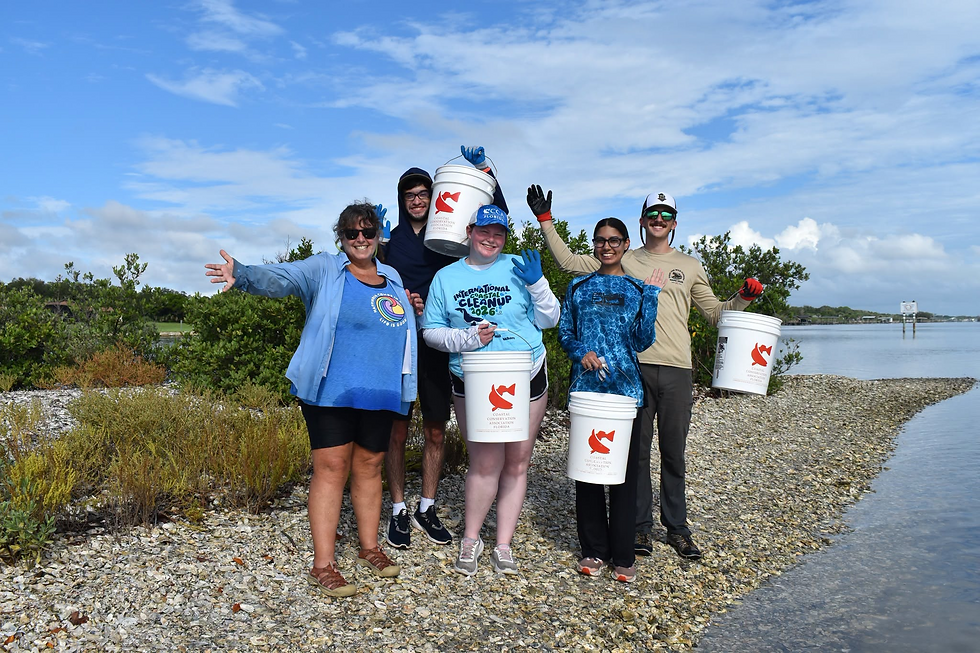
My name is Landry Goodwin and I am currently enrolled in Marine Conservation and Restoration at University of Central Florida. This is a UCF Service-Learning class with Dr. Linda Walters as the instructor. Each year, including this September, members of her class go out by boat to collect and document trash from Canaveral National Seashore’s shorelines and campgrounds.
This was the first International Coastal Cleanup (ICC) for me and three of my classmates. We arrived at Canaveral and were well taken care of by Ranger Ashley Lord and the park staff, as well as by the nice folks associated with Friends of Canaveral. As students, we love swag. So, it was no surprise that we were very happy to receive a cool t-shirt, plus work gloves, snacks from Trader Joe’s and trash bags. We joined at least 100 other volunteers in the Apollo District on this sunny Saturday morning.
Dr. Walters and her husband, Dr. Paul Sacks, took us out on a pontoon boat that started with a biodiversity tour. We saw manatee, dolphin, osprey, great blue herons and learned about mangroves and the February 2026 freeze. My favorite location was the spoil area adjacent to the Atlantic Intracoastal Waterway (ICW) as dolphins of all ages were schooling fish there for lunch.
For some background on this global event, the ICC movement was started in 1986 in Texas with 2,800 volunteers documenting what was found in their collected trash.
Fast forward to 2025, and there were 160 countries involved in the annual September event with 165,975 participants based in the United States. Organizing this effort was the Ocean Conservancy. Its goal each year continues to be uniting communities and collecting and documenting waste. Canaveral National Seashore has been involved in the ICC for many years as part of the ongoing maintenance of the park’s beloved shorelines.
“This event is a great way to bring people in the community together, to go out and do a crowd-sourcing event to clean up the beach … and keep as much stuff as possible from going back out into the water,” said Ashley Lord, ICC organizer for Canaveral National Seashore and a National Park Service Ranger for 19 years.
Coastal Cleanups are a way for many to give back to the community with participation by volunteers from nearby schools to local homeowners who frequent the waterways – and in our case, the Indian River Lagoon.
With the 2017 update to use the Clean Swell app to track types of trash on mobile phones rather than on paper, the data across various areas has become more accessible to anyone with a mobile phone. This means the data can be more accurately tracked and used for policies within local and state governments – useful from limiting types of plastic to enforcing no-glass rules on beaches. Data collected from ICC has, in fact, impacted policies in Florida in recent years.
From this data, a 2024 ruling was made that banned the intentional release of balloons, updating from the previous allowance of releasing 10 balloons per person per day. Now, any intentional balloon release is considered littering and one that could face from $150 to $1,000 fines. ICC data showed that balloons were one of the most common forms of pollution on our coasts and can be a danger for wildlife confusing balloons as food.
The Ocean Conservancy’s report, “The United States of Plastic” reports that one in three seabirds that consumed balloon fragments died as a result. Moreover, these aquatic birds were 32 times more likely to be killed by balloon ingestion than from hard plastic.
Our trash collection focused on campgrounds and other park areas where trash accumulates. As a college student, I can share that the Clean Swell app was definitely the way to go for data entry. Of the trash we collected, 43.8 percent was immediately quantified as plastic, with Styrofoam food containers taking up the most volume in our bags.
Aluminum cans and plastic bottle caps also dominated our trash. We collected one vape container and zero cigarette butts, in spite of butts being the second most collected item in global Coastal Clean-ups. Plastic beverage bottles are the No. 1 collected item, globally.
The combination of the beauty of the Mosquito Lagoon and the opportunity to improve it made for a really powerful experience for us all. We thank Canaveral National Seashore and Friends of Canaveral for making everything so easy for us to participate, and we encourage everyone to join in the 2027 International Coastal Clean Up!


Comments